About
The Feminine Time of Vesna Stefanovska
There is currently an advertisement attempting to sell a large car with the slogan “luxury is having space.” A long time ago, in the 1980s, while I was interviewing a scientist about bio-research, I was surprised when he looked at me seriously and said: “You can write this down: the real wealth of the 21st century will be time, not just money or vast properties.” Space and time have been eternal themes since the era of Aristotle, who sought to systematize questions and problems inherited from Socrates and the pre-Socratic philosophers. While we can experience space, time has a quality of its own. Its flow is lived by each of us through unique subjective interpretations, later codified to create a reading presumed to be valid for all. But what is time outside of us? It does not exist; it is we who interpret it. Vesna Stefanovska begins from this point. She expands the meaning of her work by posing questions and artistically offering fragments of truth. Her installations are visual flashes immersed in space, crystallizing the Heideggerian question of temporality. Clocks imprisoned in glass jars, goldfish confined in a bowl, or the use of mirrors and videos projected during a performance in a room with elegantly dressed, headless mannequins.
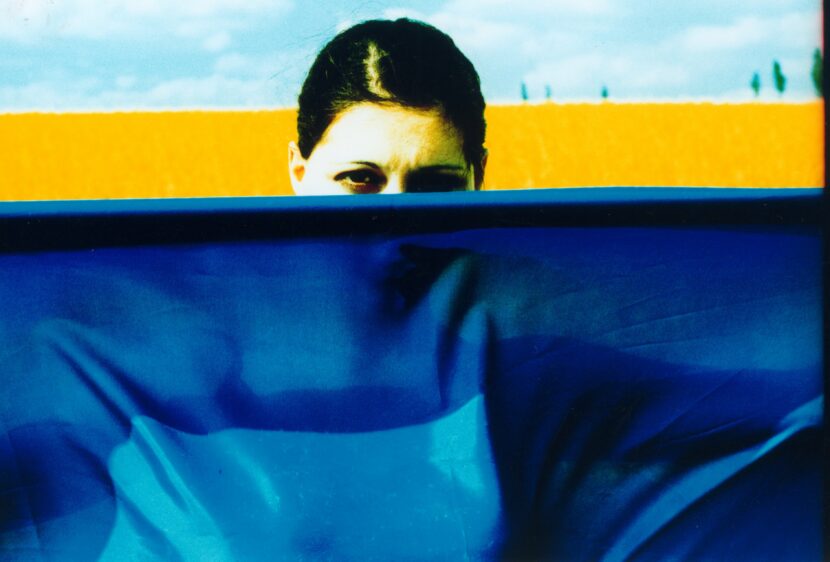
Alongside the theme of time is that of feminine identity, and this is no coincidence. Like the two young girls lying on a bed asleep, or In Deep & Dance, where a coat rack constructed with arrows displays three women’s dresses—one red, one white, and one black. In her sculptural works, there is almost always a connection to performance. For example, photographs of a woman screaming, crystal spheres suspended by nylon threads, or flags floating within a room. All immersive images addressing fundamental questions. What is the perception of reality and its passage for contemporary women, caught between the instantaneous flow of time and the pain of living between their archetypal values and the new role assumed in the modern era?
It is no coincidence that Vesna Stefanovska’s portfolio includes the field of Set Design. Fashion is an open ground for profound questions. The absolute king of the fashion world, Giorgio Armani, once stated in an interview: “Elegance is not about being noticed, but about being remembered.” And Inès de la Fressange, former top model turned eclectic Parisian designer, said: “Elegance is achieved when something matches its concept.” It almost sounds like we are hearing Descartes or a sentence drawn from Husserl. Contemporary capitalism has realized that selling is not enough. It is necessary to question and to reflect. Great artists, like philosophers, live for this purpose. With expressive and immediate themes and an apparently simple form, Vesna introduces us to a particularly complex interplay of visual elements (form, rhythm, color, light, etc.) capable of articulating space and imbuing it with a poetic dimension. This emerges with associative power, as if it were an open window onto important contemporary questions, their symbolism, and the associative function that each of us experiences in our own way.
This has always been the true mission of the artist: to translate questions, possible answers, controversies, irritations, and missing solutions into a system of images or icons, references and silences, meaning and non-meaning. Amid this absolute stillness of contemporary thought, Stefanovska reflects, imagines, and produces. A dazzling light cast upon the answers that, sooner or later, we will be compelled to provide in order to overcome the ethical decay of the society in which we live.
Paolo Manazza